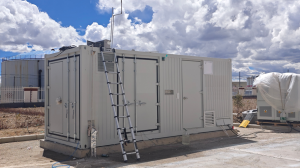
Executive Summary
high-performance computing workloads, cloud services and edge inference have pushed data centers to the intersection of two hard constraints: 99.999% availability, and increasingly specific carbon, permitting and ESG requirements. Diesel generators remain a mature, familiar and low-capital-cost backup option, but their emissions, noise, fuel logistics, maintenance burden and Scope 1 disclosure problems are turning them from an invisible insurance policy into a visible liability.
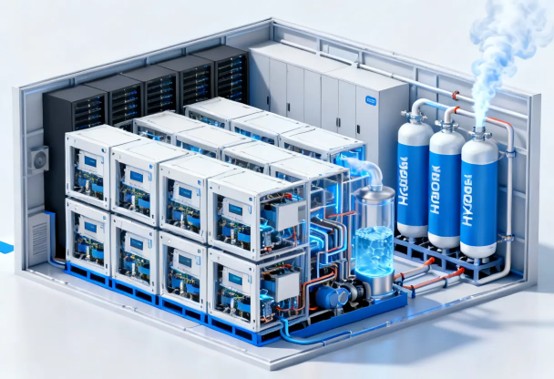
Hydrogen fuel cells generate electricity electrochemically and produce only water and heat at the point of use; paired with green hydrogen, they can approach zero-carbon operation. They are quiet, low-vibration, fast-responding and modular, and can integrate with UPS, EMS, microgrids and renewable generation. The real bottleneck is not the stack itself but hydrogen supply, storage safety, initial CAPEX, codes and certification, and operations talent.
The most realistic near-term architecture is not a one-step shift to pure hydrogen but a hybrid: batteries or flywheels handle the instantaneous bridge, fuel cells carry long-duration backup, and diesel remains a transitional layer that is phased down over time. Shanghai Mingzheng Technology Co., Ltd. (MingzhengHydro) supplies fuel cell-related equipment, system integration, environmental chamber validation, certification support and lifecycle services, helping data centers move hydrogen backup from concept to an auditable, scalable engineering solution.
- Backup Power Moves to the Core
Data centers are no longer server warehouses. A single hyperscale campus can draw hundreds of megawatts, and grid supply alone can no longer be treated as the sole guarantee. An outage does not merely interrupt a website; it can freeze AI training runs, corrupt storage clusters and trigger contractual penalties measured in millions of dollars per minute.
Carbon constraints have meanwhile entered procurement documents. Carbon-neutrality targets in China, the EU and North America are being transmitted through emissions caps, carbon pricing, permitting rules and ESG disclosure. Backup power is normally counted as Scope 1, and renewable energy certificates cannot offset emissions from diesel testing and actual operation. Backup power has therefore become the last and hardest piece of many data center net-zero roadmaps.
Diesel will not disappear overnight; that is not realistic. But it has shifted from the default answer to an exception that must be justified, and that shift has already occurred.

- Diesel: Proven, Familiar and Increasingly Exposed
Diesel generators have long dominated data centers because they are cheap, mature, widely supported and familiar to facility teams. Those advantages are being eroded by the operating environment.
Environmental and permitting pressure. A large diesel unit emits CO₂, NOx and particulate matter during both testing and outages. Urban and campus data centers increasingly sit close to residential areas, where noise complaints and permitting objections can delay expansion. Acoustic enclosures can bring noise down to roughly 75 dB, but an unhoused unit at close range can still reach 85–105 dB. Low-frequency vibration also travels through building structures.
Fuel and maintenance burden. A 10 MW load with 48 hours of backup may require roughly 100,000 liters of diesel, along with double-walled tanks, leak detection, fire suppression, bunding and secondary containment. Diesel degrades and must be polished or rotated; maintenance covers oil changes, filters, coolant, load-bank testing and emissions checks. This consumes engineering hours and generates hazardous waste.
Startup and load-following. Diesel units typically need 10–30 seconds to reach rated output, longer on a cold start. AI training loads are sensitive to voltage sags, and that gap must be carried entirely by UPS batteries, accelerating battery wear. Diesel efficiency also falls sharply at low partial load.
Supply chain risk. Fuel deliveries can be interrupted by weather, strikes or regional shortages, precisely when backup power is most needed. The diesel ledger therefore includes not only fuel price but compliance, permitting, noise mitigation, maintenance and downtime risk.
- What Hydrogen Fuel Cells Actually Solve
Hydrogen fuel cells generate electricity through an electrochemical reaction between hydrogen and oxygen. There is no combustion, so there is no CO₂, NOx or particulate matter at the point of use. When the hydrogen is produced by electrolysis using renewable electricity, the full chain can approach zero carbon. The value extends beyond decarbonization.
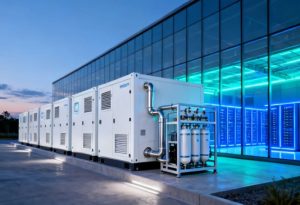
Low noise and vibration. With no reciprocating pistons or combustion pulses, fuel cells typically operate below 65 dB, with some systems in the 55–70 dB range. They are better suited to rooftops, courtyards, basements and urban campuses, reducing acoustic treatment and setback costs.
Fast response and stable output. Modern fuel cells can reach rated output within seconds, and many systems in under five seconds. Combined with lithium batteries or flywheels, the transfer can be made effectively seamless for IT loads. Stack output is stable, and power conditioning delivers high-quality AC power.
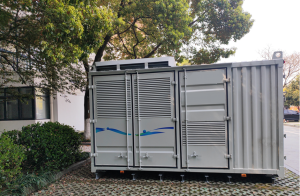
Modular scaling. Capacity can be added module by module as racks are commissioned, avoiding an oversized diesel plant built for a theoretical peak. This is friendlier to capital planning: cover part of the critical load first, then expand with IT capacity.
Lighter maintenance. There is no engine oil, coolant flush, fuel injection or exhaust aftertreatment. Routine service is largely limited to filters, stack health monitoring and hydrogen leak detection. The source document cites maintenance cost reductions of 50%–70%.
System integration. Fuel cells can coordinate with UPS, EMS, microgrid controllers, solar and wind. Surplus renewable electricity can produce hydrogen for storage, enabling long-duration storage measured in days or weeks, a scenario lithium batteries struggle to cover.
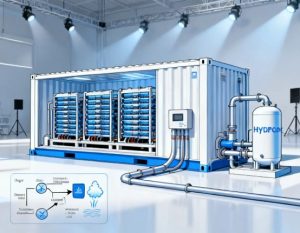
- Hard Data: Hydrogen Fuel Cells vs Diesel Generators
The figures below are directional. Actual values depend on system size, load profile, hydrogen price, duty cycle and local regulations.
Dimension | Diesel Generator | Hydrogen Fuel Cell System |
Point-of-use carbon | About 2.7 kg CO₂/L; about 0.7–0.8 kg CO₂/kWh; includes NOx and particulates | Near zero with green hydrogen; no combustion-related pollutants |
Electrical efficiency | Typically 35%–40% | 42%–55%, higher with heat recovery |
Noise | About 75 dB with enclosure; 85–105 dB at close range unhoused | Typically below 65 dB; some 55–70 dB, low vibration |
Startup response | 10–30 seconds, longer when cold | Seconds; many under 5 seconds; seamless with battery hybrid |
Maintenance | Oil, filters, coolant, fuel polishing, load testing | Few moving parts; 50%–70% lower maintenance cost |
Fuel and storage | On-site diesel tanks, rotation and leak detection | Pipeline, tube trailer or on-site electrolysis; no diesel degradation |
Service life | Major overhaul every 10–15 years | Stack around 20,000–40,000 hours, modular replacement |
Footprint | Tank farm, exhaust stack, acoustic treatment | Compact; indoor or rooftop capable |
TCO | Lower initial CAPEX, rising operating and compliance cost | Higher initial CAPEX; 15-year TCO can reverse at high utilization |
What convinces finance teams is not the emissions row but efficiency, maintenance and TCO. Fuel cells hold efficiency more steadily across a wide load range, which suits the variable demand of modern compute halls. Modularity matches investment to actual rack occupancy rather than building for a theoretical peak. Once carbon pricing, permitting, noise mitigation and maintenance labor are included in a 10–15 year model, the hydrogen TCO advantage becomes clearer, particularly at sites with high test frequency or weak grid connections.
- Practical Barriers: Hydrogen Is Not Plug-and-Play
Hydrogen supply is the first question. Most data centers are not near a hydrogen pipeline and must rely on tube-trailer delivery, on-site electrolysis or natural gas reforming. Reforming undermines the zero-carbon claim. The carbon intensity of the hydrogen determines the environmental case; green hydrogen carries a premium but delivers the full benefit. Storage choice also shapes design: 350/700 bar compressed gas, liquid hydrogen and metal hydrides each carry different footprint, boil-off and safety requirements.
Safety and codes. Hydrogen is flammable and leaks easily. Detection, ventilation, ignition control and separation distances must be designed in from the start rather than retrofitted. ISO 22734, IEC 62282 and NFPA 2 provide frameworks, but local fire, building and electrical approvals are still maturing. Early engagement with fire authorities and insurers reduces late-stage rework.
CAPEX and financing. Fuel cells still cost more per kilowatt than diesel, and hydrogen storage, piping, ventilation and control integration add further budget. Subsidies, green finance, PPAs and energy-as-a-service can improve payback, but eligibility rules vary by jurisdiction.
Site and retrofit. Existing diesel rooms were designed around liquid fuel, exhaust stacks and acoustic treatment. Converting to hydrogen requires new piping, ventilation, detection, structural review and electrical interfaces. Older sites may lack space, and roof and floor loading must be verified.
People and operations. Facility teams familiar with diesel are not automatically familiar with hydrogen. Training must cover hydrogen safety, stack monitoring, emergency response and remote diagnostics. Documented procedures and supplier remote support shorten the learning curve.
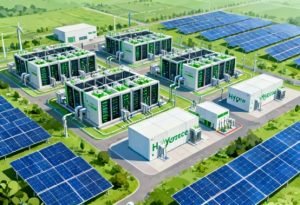
- Industry Trends: From Pilots to Standard Green Computing Infrastructure
Policy is accelerating adoption. National hydrogen strategies, green data center rating systems, local building codes and restrictions on new diesel permits in some cities are all pushing zero-emission backup. Carbon disclosure, renewable-energy ratios and customer audits have moved backup power out of the back office.
Hyperscale and colocation operators have moved from press releases to construction schedules. The dominant near-term architecture is hybrid: lithium batteries handle the instantaneous transfer, fuel cells carry extended runtime, and diesel remains as a transitional layer. As green hydrogen supply expands, electrolyzer costs fall and codes mature, the diesel layer is expected to shrink.
Microgrids are a natural fit for hydrogen. Solar and wind can charge batteries and supply surplus electricity to electrolyzers; when renewable output falls or the grid fails, the fuel cell generates again. The same assets serve resilience, sustainability and grid interaction. In China, industrial policy and expanding hydrogen production capacity are accelerating adoption in new-build campuses.
- The Role of Mingzheng
Mingzheng is the hydrogen energy brand of Shanghai Mingzheng Technology Co., Ltd. Its position is not hardware sales alone but the combination of hydrogen equipment and environmental validation capability. Reliability claims for data center backup must be proven under temperature, humidity, cycling and load conditions; otherwise they will not convince owners, fire authorities or insurers.
Mingzheng’s capabilities cover:
- Fuel cell-related equipment;
- System design, integration and commissioning;
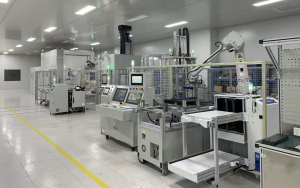
- Environmental chamber testing and reliability validation;
- Safety, certification and compliance documentation support;
- Remote monitoring, O&M and stack replacement planning.
For data centers, this provides a single accountable interface rather than a collection of components. Related resources include Solution, About Us, Support, Environmental Chamber and Fuel cell-related equipment.
- Recommended Path: Assess, Pilot, Scale
The first step is not equipment purchase but a feasibility assessment: load profile, redundancy architecture, required backup duration, site constraints, hydrogen sourcing options, permitting path and 15-year TCO. The assessment should answer a specific question: can a battery-plus-fuel-cell hybrid meet first-phase requirements, and how much diesel can it displace?
The second step is a pilot. A 1 MW-class installation covering a defined critical load, measuring efficiency, stack degradation, hydrogen consumption, transfer performance and hydrogen logistics, is a sensible starting point. Run it for 12–24 months before deciding on campus-wide expansion. This cadence matches how data centers already plan IT capacity: validate first, then replicate.
The third step is scale. As hydrogen supply, codes and the cost curve improve, expand fuel cell coverage, reduce the diesel share, and convert backup power from a Scope 1 liability into a zero-carbon resilience asset.
Selected FAQ
Can hydrogen fuel cells fully replace diesel?
In new-build designs, yes, particularly with a fuel cell-plus-battery hybrid architecture. For existing sites, phased replacement is more realistic. The constraint is usually hydrogen supply and storage rather than stack technology.
Can they support 99.999% availability?
Yes. Modular redundancy, few moving parts, remote diagnostics and predictive maintenance can support Tier IV-level targets. The key is design, commissioning and operational discipline.
How much carbon can be avoided?
Diesel emits about 0.7–0.8 kg CO₂/kWh. A 1 MW facility running 200 backup hours a year can avoid more than 140 tonnes of CO₂. With green hydrogen, point-of-use emissions are near zero.
Is it safe?
Designed to standards such as ISO 22734, IEC 62282 and NFPA 2, with hydrogen detection, ventilation, separation and training in place, deployment can be safe. Hydrogen behaves differently from diesel, and fire authorities and insurers need early engagement.
What about cost?
CAPEX remains higher than diesel, but maintenance, compliance and fuel degradation costs are lower. At high utilization, 15-year TCO can reverse. The right comparison is lifecycle cost, not sticker price.
Conclusion
Data center competitiveness now includes compute density, energy efficiency and low-carbon capability at the same time. Diesel solved the reliability problem of an earlier era, but its emissions, noise, permitting and maintenance burdens increasingly conflict with modern uptime and sustainability targets. Hydrogen fuel cells offer a credible alternative: zero-carbon operation, low noise, modularity, fast response, and integration with renewables and storage in a microgrid.
Barriers remain: hydrogen supply, storage safety, CAPEX, codes and talent. They are being addressed through policy, manufacturing scale and pilot projects. For operators, the question is no longer whether to move to hydrogen but when, at what pace, and starting from which load. The path is clear; what remains is project discipline: settle the hydrogen source and TCO first, then pilot, then scale.