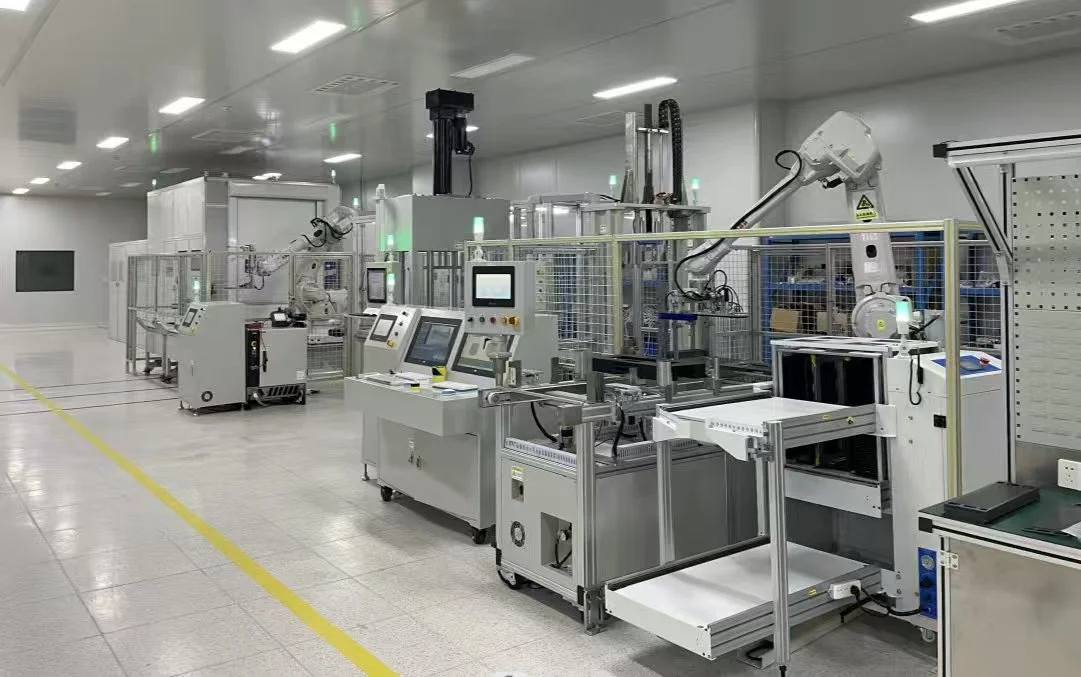
Mingzheng Technology has started up a new PEM fuel cell stack assembly line at its Shanghai facility. The line is built for industrial power and energy storage stacks—not pilot-scale runs, but real production volume.
The process runs through MEA preparation, bipolar plate sealing, automated stacking, compression fastening, and leak testing. The stacking station uses precision positioning gear to align MEAs and plates in sequence; the compression rig applies controlled force to keep stack integrity consistent. The line handles different stack sizes and power ratings with automated fastening and bracing stations that swap configurations without a full teardown.
Quality gets built in at every step, not inspected at the end. An MES tracks key parameters per station, giving full traceability from component load-in to finished stack. Leak testing and visual inspection happen online—if a unit doesn’t pass, it doesn’t move downstream.
The real gain here is flexibility. The line supports multiple stack platforms and changeovers that don’t kill productivity. It runs in a controlled environment—temperature, humidity, cleanliness—all held to spec. That consistency translates directly to product quality.
With this line online, Mingzheng now handles stack assembly in-house at scale. That matters because the stack is the core of any hydrogen power system. The line is already supporting ongoing deliveries of fuel cell systems for industrial and commercial customers.